
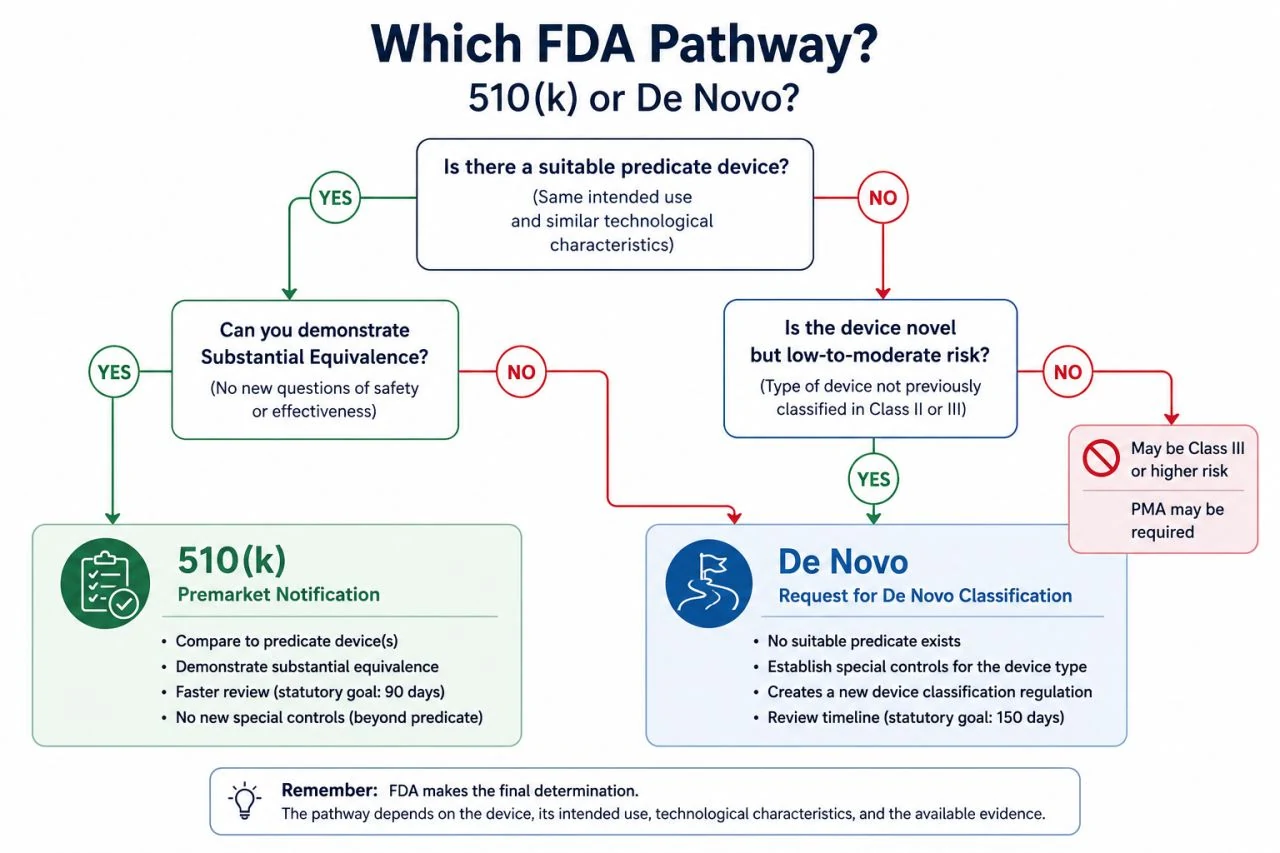
When discussing regulatory strategy, one question comes up again and again:
“Can this device be cleared through the 510(k) pathway?”
In reality, that question is often more complex than it sounds.
The question is whether the device meets the statutory requirements for a 510(k)—specifically, whether there is an appropriate predicate and whether substantial equivalence can be demonstrated.
In some cases, additional reference devices may also be useful to support comparisons of specific technological characteristics, but they do not replace the need for an appropriate predicate.
If those requirements cannot be met, a De Novo may be the appropriate pathway for a novel, low-to-moderate risk device.
The challenge is that it isn’t always obvious.
Technology, intended use, indications for use, risk profile, and available predicates all matter.
One of the most important jobs of a regulatory consultant isn’t predicting FDA’s decision—it’s helping clients understand the regulatory risks, prepare the strongest evidence package, and navigate the most likely regulatory pathway.
That’s why I encourage teams to spend less time asking, “Can we get a 510(k)?” and more time asking:
- What predicates are realistically defensible?
- Where are the technological differences?
- Could FDA view those differences as raising different questions of safety or effectiveness?
- If substantial equivalence cannot be established, what evidence would support a De Novo?
What factors have you found to be the biggest drivers in determining whether a device can be cleared through the 510(k) pathway?
Let’s connect these ideas
to your next milestone.
Schedule time with Strata to discuss your device, priorities, and questions.
Schedule an intro callEducational content only. No company-specific regulatory or legal advice.